REBUILT AND REBUKED
- Matt Rowell
- Aug 27, 2025
- 4 min read

The Refusal
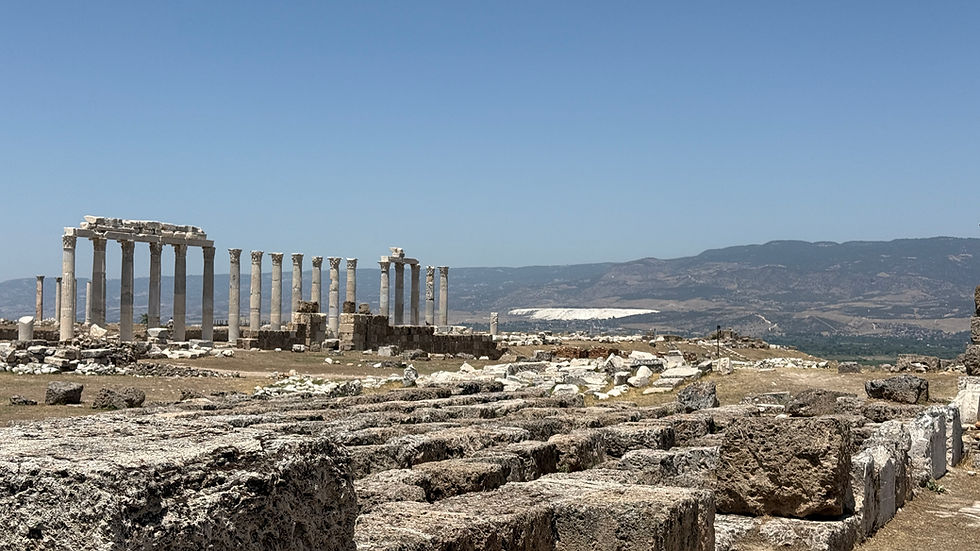
In Asia Minor, Laodicea was an important and affluent center in the first century. Its wealth came especially from banking and wool, the latter distinguished mostly by its kind used in garments and for which Laodicea was well-known. In fact, the black wool that was produced in Laodicea was the most sought-after. But in addition to all these factors, wealth and a specific product distinguished from others by its quality, Laodicea had a medical school that were significantly influential, not just locally, but also throughout the Greco-Roman world.
The Earthquake
During Emperor Nero's rule, Asia Minor underwent a number of disastrous earthquakes. Among the most destructive was one which occurred around 60 or 61 A.D., laying waste to the cities of the Lycus Valley. Noting the disaster in his history of the Romans, Tacitus tells us that a number of cities ask the emperor for funds to help them rebuild. Such subsidies were a common form of imperial benefaction and were regularly used to demonstrate just how generous the emperor was and to connect the cities more closely into the web of Roman patronage.
The city, however, was different. Tacitus records that "Laodicea arose from the ruins by the strength of her own resources and without assistance from us.”[1] This abrupt and striking statement reveals much about the city’s wealth, independence, and pride. Where other cities implored for funds from the imperial purse, Laodicea audaciously asserted that it needed nothing from Rome.
The Wealth
Laodicea's refusal of imperial assistance was not an expression of impatience, but of self-confidence. The city had more than enough financial resources to mount a reconstruction effort. Its institutions of finance had made it a local banking capital, holding within its walls a considerable quantity of gold. Merchants traded in the famous glossy black wool for which the region was known, weaving and selling textiles that were among the most fashionable in the empire. They were also known for an eye ointment, made of “Phrygian powder,” which was produced by the famous medical school.
The Power
Rejecting imperial aid had political ramifications, too. In the Roman Empire, accepting money amounted to accepting patronage. Laodicea, however, seems to have had the fortitude to refuse such an arrangement. In that, Mark Fairchild argues that most people in the city must have applauded this because civic pride was at stake.[2] To refuse aid and still manage to survive economically takes not just a lot of self-confidence but also a fair measure of wealth. After all, any city that could refuse imperial funds, after experiencing such a calamity, seems to have a reputation to uphold.
The Church
The essential nature of this historical backdrop cannot be overstressed in relation to Christ's statements to the Laodicean church that He makes in Revelation 3:17:
You say you are wealthy, you have succeeded, and you need nothing, not seeing that you are deserving of sympathy, are without comfort, are short of riches, have no sight, and are shamelessly unadorned.
The resonance is undeniable. Just as the metropolis displayed its financial competence by convincing Rome that they were “in need of nothing”—not even from the emperor, it seems the ecclesia had adopted this very attitude, spiritually. They misjudged physical wealth for spiritual worth. Yet Christ reveals the deeper truth: underneath their public affluence, they were spiritually bankrupt!
Craig Keener emphasizes that the character of John’s exhortation comes into sharper relief against the backdrop of a self-sufficient civic identity of Laodicea. The church’s complacency reflected the city’s pride, and its wealth had blinded it to its spiritual condition.[3]
David deSilva stresses that the city’s history is used rhetorically in Revelation. He argues that the city’s wealth and independence serve as a reflection of the church’s spiritually impoverished condition, wherein the only factor that could bring a resolution to the church is the provisions of Christ and not the world.[4] The history of the city becomes transformative, taking a local boast and turning it into something that serves as a theological indictment.
Laodicea's narrative resonates strongly with contemporary audiences. The financial affluence can yield an impression of autonomy and self-reliance, lulling people into a stupor of apparent satisfaction. Yet this secure, gated perception of life disguises a poorly understood and poorly responded-to spiritual condition. Laodicea's story serves as a contemporary cautionary tale.
The Laodicean church may have experienced, whether directly or indirectly, the prosperity of the city, but they were blind to the purpose and expectations of Christ in his kingdom. Jesus wasn't calling them to a life of poverty; he was calling them to a life of spiritual richness and dependence on him.
The Lesson
The lesson learned from the letter to the Laodiceans is that sufficiency isn't found in material wealth, but in Jesus Christ. Wealth can render momentary satisfaction and status for a moment, but it can't achieve everlasting life or sincere spiritual wholeness.
The earthquake of 60-61 A.D. may have revealed Laodicea's immense wealth. It revealed the city's independence; it rebuilt, without help from Rome, and its act of civic pride became a defining feature of Laodicea's identity. Yet it also became the church's warning. Revelation 3:17 writes Laodicea's act of rebuilding into the church's story, reframing the history as a spiritual warning. Laodicea rebuilt itself, yes, but it was blinded by acts of pride and self-reliance, which made it impossible to see the poverty in its spirit.
The Conclusion
The text deepens our understanding of where archaeology, history, and biblical studies come together. Laodicea's boast, "I need nothing," issues a warning that reverberates across the centuries. It holds a mirror up to us and asks, "Are you really in need?" True privilege, Christ reminds us, comes only from him. Only with the Lord's measure are we truly with it.
[1] Tacitus, The Annals of Imperial Rome, trans. Michael Grant (New York: Penguin Classics, 1996), 14.27.
[2] Mark R. Fairchild, Christian Origins in Ephesus and Asia Minor (Eugene, OR: Cascade Books, 2017), 229–30.
[3] Craig S. Keener, The NIV Cultural Backgrounds Study Bible (Grand Rapids: Zondervan, 2016), 2302.
[4] David A. deSilva, Seeing Things John’s Way: The Rhetoric of the Book of Revelation (Louisville: Westminster John Knox, 2009), 198–200.


Comments