EXILED BUT NOT SILENT
- Matt Rowell
- Jun 18, 2025
- 6 min read


Many of us, when we open our Bibles to the book of Revelation, find ourselves immersed in a world of bright visions, cosmic fights, and apocalyptic imagery. It is wild, it may seem odd, and it is unlike anything else in the New Testament. But before we dive into the dragons, trumpets, and thrones, we must ask: Who was this John? Why was he on Patmos? And what was the world around him getting up to?
Comprehending the history, culture, and political environment of John's exile allows us to interpret Revelation as a potent declaration of hope and resistance sent to a troubled church in an empire rocked by upheaval, not as some kind of mysterious codebook for the finale of human existence.
An Apostle in Exile
John’s letter to the seven churches of Roman Asia Minor begins with these words:
“I, John, your brother who share with you the persecution and the kingdom and the endurance in Jesus, was on the island called Patmos because of the word of God and the testimony of Jesus.” (Revelation 1:9, NRSVUE)
John calls himself a brother, a partner in suffering, and a faithful witness. Most scholars hold that this is the same John who, following Jesus, wrote the Gospel of John, served as an Apostle of Christ, as well as a Pastor to the Church at Ephesus. He also served as a revelator to the seven churches in Asia Minor, in modern-day western Türkiye. John’s apocalyptic visions and revelation occurred as he was exiled to the Isle of Patmos.[1]
Patmos was a small, rocky isle in the Aegean Sea—roughly 7 miles long and 3 miles wide. It was not a place where one would vacation; it was similar to a first-century Alcatraz. The Romans commonly exiled political dissidents, along with religious nonconformists and anyone else they considered a menace to the imperial peace, to remote islands like Patmos.[2]
Why, then, was John exiled? In his own words, he tells us it was "on account of the word of God and the testimony of Jesus." So to be clear, John wasn't sent off for reasons like tax fraud or civil disobedience. He was sent to Patmos because he wouldn't stop preaching the gospel in a time when doing so was, in the eyes of Rome, something akin to defiance.
One True Lord
The written time of Revelation was approximately 95 AD, and then the Roman Empire held the height of its power. Then Emperor Domitian ruled, and he combined military might with significant religious propaganda and an intense dose of paranoia.[3]
Roman emperors did not simply rule over a polity. Increasingly, they were viewed as divine.[4] Statues of the emperor went in icons of temples, and across the whole empire, he subjects were expected to light incense and declare, "Caesar is Lord." It was the glue holding the empire together. The public loyalty of the populace to the emperor signified the public stability of Rome.
This became very problematic for Christians. They believed, and boldly confessed, that Jesus is Lord, not Caesar. This wasn’t just a private spiritual statement. It was a public declaration that placed them in direct conflict with imperial ideology. To refuse emperor worship was considered an act of treason.
The Church in Roman Asia Minor
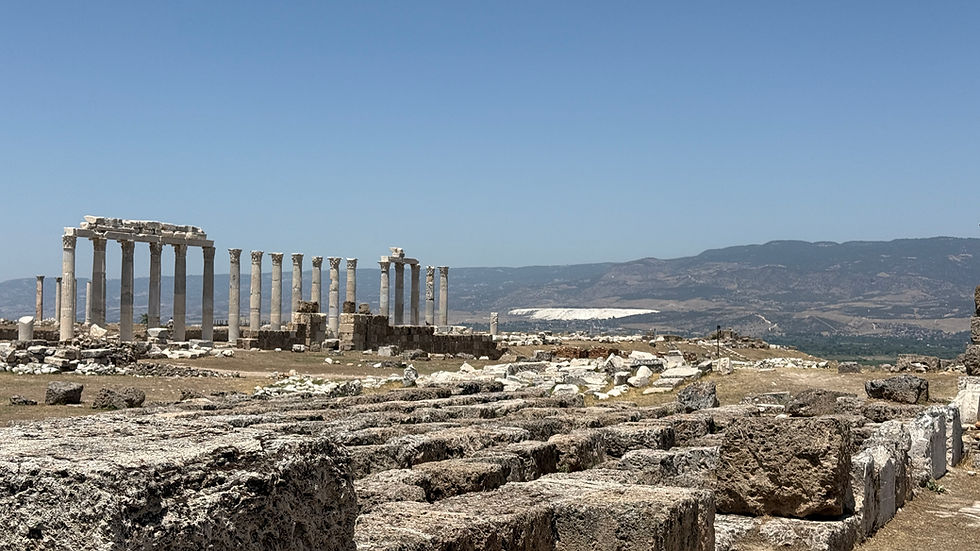
The seven churches of Asia Minor—Ephesus, Smyrna, Pergamum, Thyatira, Sardis, Philadelphia, and Laodicea—that received the book of Revelation were real communities of believers. They lived in a very real world and faced an array of difficult, challenging situations. Persecution put some of these congregations to the test. Others had begun to straddle the fence, compromising with the surrounding culture and trying to be all things to all people. Still other churches had settled into a comfortable routine and were just going through the motions, and had seemed to have lost their sense of devotion and urgency.[5]
Each of these cities had its relationship with the power of Rome. Some were more dedicated than others, putting up temples in honor of the emperor and celebrating the sort of imperial festivities that loyal provincial cities were expected to hold. Living in one of these cities as a Christian meant making daily decisions about whether to conform to the expectations of the citizens in whose city you lived or to resist and risk being reported.
Imagine yourself living in the first century, as a follower of Jesus. Would you comply or lose your livelihood if your trade guild required you to offer sacrifices to Roman gods? Would you celebrate Caesar as divine if it meant you had to be seen as disloyal and not a team player? Would you say that Caesar is Lord and give your allegiance if the authorities demanded it, or would you suffer the consequences of not doing so?
The political climate was tense. Loyalty was demanded in Rome. Jesus was professed by the Church. Something had to give.
A Proclamation of Hope
Even amid Roman power, John pens the “book” of Revelation. It is not an escape fantasy, but a prophetic work suffused with pastoral courage and political clarity. The visions he sees in the heavenly realm unveil the spiritual reality behind worldly power, and a revealing of Christ in the Heavens.
The Beast was not a future dictator. It was a representation of the might and authority of Rome, both militarily and politically. Jesus—the Lamb who was slain—was the true Lord of history, the one who conquered not using violence but through sacrifice.
John's visions are intense. What was at issue was the very authority of the churches. They needed to know, once and for all, that the powers of Rome were not eternal. And that, despite appearances, Jesus is King, and that the persecution and suffering they were enduring was not the end-all for them.
His letter was not merely a prediction; Revelation is a proclamation. It declares to every generation, above all those under duress: God is on the throne. Jesus is the victor. Stand firm in the faith!
The Church Continues
You probably aren't facing Roman persecution. And you may not be exiled to a rocky island. But the pressures are still real.
The world we inhabit continues to honor power, wealth, and compromise. We are still tempted to dilute our testimony, to mix in with societal ideologies, or to look the other way in the face of injustice when doing so allows us to enjoy the status quo.
Revelation invites us, just like those believers in the first century, to look at life and the world through the lens of divine reality. It calls us to something very countercultural: to behold the Lamb in the throne room of heaven, while all around us in the real world the idols of our age (more on that in a moment) vie for our attention, affection, and allegiance.
We may feel cut off or pushed to the edge of the world, just as John did. We may think our voice is nothing but a whisper. But exile isn’t the same as silence. Even in solitary confinement, John gave witness to an important vision laid out in the most powerful book of the New Testament. God can take a lonely island and turn it into a beacon of hope that shines clear to the far reaches of the world.
The Enthroned Lamb and King
Viewing John on Patmos reminds us that the Word of God cannot be imprisoned and that even in exile, God can and does speak. And when the powers of this world seem utterly overwhelming, we must remember that there is another throne, another King, and another Kingdom breaking in.
He calls us to lift our eyes to him. The Lamb is on the throne! It matters that you are being faithful. And even in the midst of challenges, your witnessing can echo through each generation, just as it does with John.
Let us be a people who see through the empire's fog and remain true to the Lamb, till the day he makes all things new.
“and from Jesus Christ, the faithful witness, the firstborn of the dead, and the ruler of the kings of the earth.To him who loves us and freed us from our sins by his blood and made us a kingdom, priests serving his God and Father, to him be glory and dominion forever and ever. Amen. (Revelation 1:5–6, NRSVUE)
[1] Richard Bauckham, The Theology of the Book of Revelation (Cambridge: Cambridge University Press, 1993), 2–4.
[2] David A. deSilva, An Introduction to the New Testament: Contexts, Methods and Ministry Formation (Downers Grove: IVP Academic, 2004), 887.
[3] G.K. Beale, The Book of Revelation (New International Greek Testament Commentary; Grand Rapids: Eerdmans, 1999), 4–6.
[4] Larry Hurtado, Destroyer of the gods: Early Christian Distinctiveness in the Roman World (Waco: Baylor University Press, 2016), 136.
[5] Colin J. Hemer, The Letters to the Seven Churches of Asia in Their Local Setting (Grand Rapids: Eerdmans, 2001).


Comments